Which wool is the warmest? Find the fibre that suits you
Which wool is the warmest? If you are choosing between sheep wool, yak wool, camel hair and cashmere, it helps to understand what each fibre offers and how you want to wear it.
There are small things that make a cold day more enjoyable. A warm cup of coffee between your hands. A scarf pulled a little closer around your neck. Soft socks waiting for you when you get home.
You barely think about them. Until you notice how lovely it feels when your clothing gives you exactly what you need.
Yak wool showed favourable insulating properties in a published Mongolian comparison of heat transfer. Sheep wool, camel hair and cashmere can also make warm clothing. The warmth of a finished product depends on its thickness, construction and fit as well as the fibre itself.
Each material has something to offer. Choosing becomes easier when you picture the moments you want to wear it.
Why does wool keep you warm?
Wool’s warmth begins with something you cannot see: the air between the fibres.
These small pockets help hold your body heat close. The natural waviness of sheep wool, known as crimp, helps create this structure. It allows wool textiles to insulate without necessarily feeling heavy. Woolmark explains how wool’s structure works.
Wool can also absorb water vapour within its fibres. This matters when you warm up or move between indoors and outdoors. Comfort depends partly on how a material handles moisture around your skin. Read Woolmark’s explanation of wool and moisture.
Of course, you do not want to think about fibre science every time you get dressed. You want to wrap yourself in a scarf, pull on your favourite socks and enjoy your day.
Sheep wool: warmth for everyday life
Some things quietly become part of your routine. The mug you always reach for. A favourite jumper. The socks you put on first after washing them.
Sheep wool fits naturally into that everyday comfort. It is a versatile fibre for socks, hats and other clothing you wear regularly.
How a product feels depends on the selected wool and the way it is knitted. Sheep wool can have different textures, from supple to more substantial. With socks, it is also worth checking how they fit and how much room remains in your shoes.
In our collection, sheep wool socks are the choice for everyday wear. For an ordinary working day, a chilly morning or a relaxed moment at home.
They are an accessible introduction to undyed Mongolian wool, with natural colours that are easy to make part of your wardrobe.
Wool socks | explore our undyed Mongolian sheep wool socks
Yak wool: warmth beneath a rugged coat
At first glance, a yak looks impressive. Large, shaggy and covered in long hair. Perhaps not the animal you would immediately associate with a soft scarf.
Beneath those coarse outer hairs lies a fine undercoat. This is the fibre that is particularly interesting for soft textiles.
Research into Mongolian yak fibres shows differences between the fine undercoat and the coarser hair. Selecting the right fibres matters. Explore the research into Mongolian yak fibres.
Is Yak Wool Warmer Than Sheep’s Wool?
A Mongolian technical publication reports lower heat transfer for yak wool than for sheep wool, cashmere and camel hair in its comparison. This points to favourable insulating properties within that comparison. Read the comparison in this publication about yak wool.
For a finished pair of socks or a scarf, thickness and construction also influence warmth.
Our yak wool socks have their own place in the day: quiet moments at home, worn without shoes. When you settle onto the sofa, open a book or linger at the kitchen table.
A yak wool scarf brings the material into a different part of your routine. You feel it around your neck on those fresh mornings when a soft, warm layer is especially welcome.
Camel hair: warmth in natural shades
One of the first things you notice about camel hair is its colour.
Soft beige, warm brown and the subtle shades in between. Colours that sit comfortably alongside a winter coat, a wool jumper or your favourite clothes for relaxing at home.
Fine textiles primarily use the soft undercoat. In the Mongolian comparison discussed above, camel hair had a reported heat transfer value close to that of yak wool.
It deserves attention alongside the more familiar choices of sheep wool and cashmere.
You can appreciate a fibre for its insulating properties, but also for the way it looks and feels. A camel hair scarf already has character in its natural shade.
At Mongolian Magic, we leave that colour as it is. We do not need a dye bath to create beige or brown. Those shades come from the animal.
Camel hair socks | discover our undyed camel hair socks
Cashmere: softness for when you get home
There is a moment when the pace of your day changes. You take off your shoes. Make something to drink. Sit down.
That is the kind of moment our cashmere socks are made for.
Cashmere comes from the fine undercoat of the cashmere goat and is valued for its soft, light feel. It is a material you get to know through the way it feels against your skin.
In our collection, cashmere socks are a soft comfort layer for home, worn without shoes. For a quiet evening on the sofa or a little warmth while you relax in bed.
Is cashmere the warmest wool?
Cashmere can make warm clothing. How it is processed and knitted plays an important part.
Research into cashmere knitted fabrics shows that changes to the knitting structure and yarn affect properties related to thermal comfort. Explore the research into cashmere knitted fabrics.
For many people, cashmere’s appeal lies in its combination of warmth, fineness and softness. That makes it a lovely choice for moments when comfort comes first.
Cashmere socks | discover the feel of cashmere
Which wool is the warmest for socks, scarves and hats?
Start with the moment you want to wear them.
For everyday wool socks, our sheep wool socks are a natural starting point. Choose a comfortable fit and allow enough room in your shoes.
For soft socks during quiet moments at home, explore our yak wool and cashmere socks. Wear them without shoes and discover which feel you enjoy most.
With a warm scarf, softness, thickness and coverage all matter. Our yak wool and camel hair scarves each bring their own natural colour and texture.
For a warm wool hat, fit and coverage are important too. A hat that sits comfortably over your ears can make a welcome difference on a chilly walk.
Different fibres can find different places in your day. You might reach for sheep wool in the morning and choose cashmere when you get home. Your favourite does not have to be the same for every occasion.
Which socks are best for cold feet?
Four Mongolian fibres, each with its own character
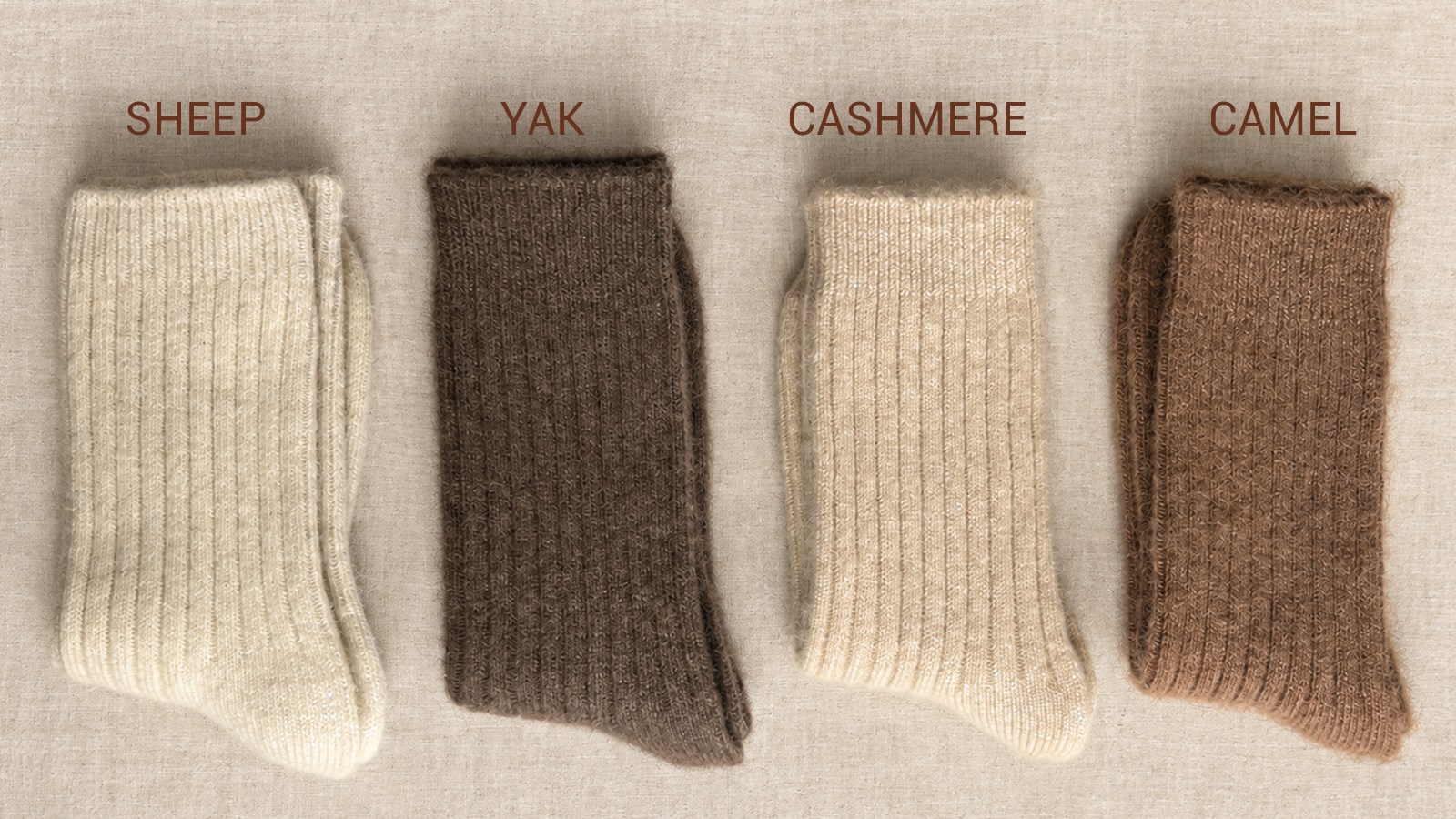
At Mongolian Magic, we work with sheep wool, yak wool, camel hair and cashmere in their natural, undyed colours.
Those shades give each fibre its own appearance. You can see the differences as well as feel them.
For our socks, we use yarn made from undyed animal fibres. The animal fibre yarn itself is not blended with synthetic fibres. Separate technical threads are added during knitting to support stretch, fit and shape retention. You will find the full composition on each product page.
If you would like to get to know all four fibres, The Mongolian Four Discovery Box brings together four complete pairs: sheep wool, yak wool, camel hair and cashmere.
Discover each pair in its own setting. Sheep wool during your everyday routine. Camel hair when you want warmth in natural shades. Yak and cashmere at home, once your shoes are off and it is time to relax.
You may find yourself reaching for one pair during the day and another when the evening slows down.
The Mongolian Four Discovery Box | get to know the four Mongolian fibres
Frequently asked questions about the warmest wool
Which type of wool is the warmest?
Yak wool showed favourable insulating properties in the Mongolian heat transfer comparison discussed here. The warmth of a finished garment also depends on its thickness, yarn and construction.
Is yak wool warmer than cashmere?
Yak wool had a lower reported heat transfer value than cashmere in the cited comparison. This does not automatically determine which finished product will be warmer. Both fibres can be used to make warm, soft textiles.
Which wool socks should I choose for everyday wear?
Within our collection, sheep wool socks are the choice for everyday wear. Choose a size that fits comfortably and leaves enough room in your shoes.
When should I wear yak wool or cashmere socks?
Our yak wool and cashmere socks are intended for quiet moments at home, without shoes. They are lovely for relaxing on the sofa or enjoying a peaceful evening.
Is camel hair suitable for winter?
Camel hair is used for warm socks, scarves and blankets. The thickness and construction of each product determine how much warmth and coverage it provides.
How should I care for Mongolian Magic socks?
Always wash them gently by hand, using a suitable wool detergent and water no warmer than 30 °C. Avoid rubbing or wringing, and lay them flat to dry. Do not use a washing machine or tumble dryer.