Do animals in Mongolia live organically by default? The truth behind Mongolian wool, tradition and nature
Organically living animals in Mongolia form the foundation of the natural wool production the country is known for. In a world where the word organic is increasingly used as a marketing term, there is a place where this way of life does not need a label. There is no certification. No seal. No certificate. And no packaging with green claims. In Mongolia, organic is not a promise, but a daily reality.
But is it really true that animals in Mongolia live organically as standard? And what does that mean for products such as Mongolian wool, yak wool and cashmere? In this article, we take an in-depth look at the origins, the animals’ way of life, and the difference between European certification and organic reality.
This is not a superficial story. This is the full context.
What does organic really mean?
In Europe, organic is a legally protected term. It stands for a controlled system with rules, audits and certificates. Think of restrictions on antibiotics, space per animal, nutrition and origin of raw materials. But organic did not start out as a system. It started as a natural way of life. Animals that move freely. Grazing on natural land. Living according to the seasons. Without intensive intervention.
And that is precisely what sets Mongolia apart.
The Mongolian standard is freedom.
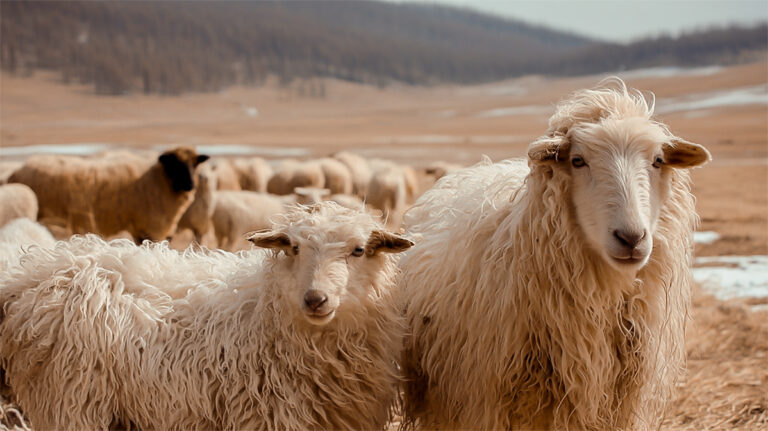
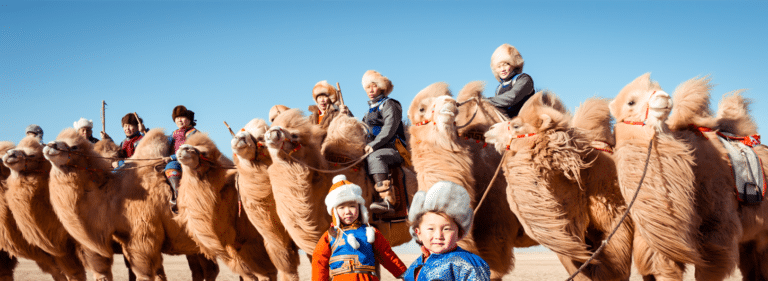
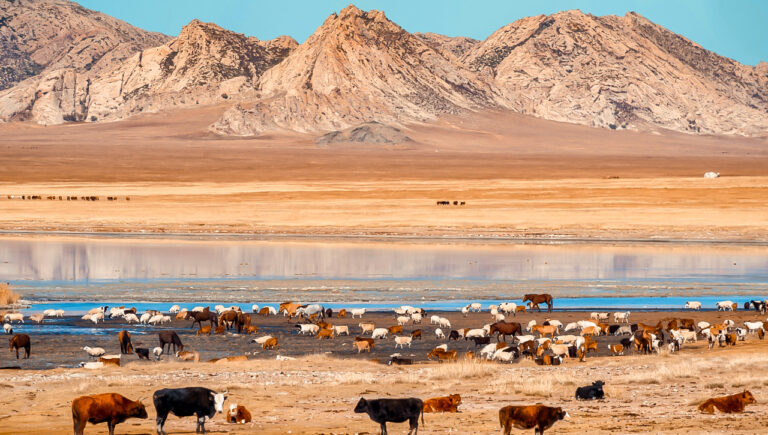
More than a third of the Mongolian population still lives as nomadic herders. The reason Mongolian wool is so pure stems from the fact that organically raised animals in Mongolia are free to graze on the vast steppe. Their animals are not an industry but a lifeline. Sheep, goats, yaks, camels and horses roam freely across the open steppe, sometimes travelling hundreds of kilometres a year, guided by climate, grass growth and instinct. There are no mega-stables. No overcrowding. No artificial growth stimulants. Animals live outside, day and night, summer and winter. They eat what the land offers and drink from natural sources. What is called organic in Europe is simply normal in Mongolia.
No concentrated feed, no hormones, no routine antibiotics
A crucial difference with intensive livestock farming is nutrition. Mongolian animals are not fed imported concentrated feed or soya. They graze on wild grasses, herbs and plants that grow naturally on the steppe.
Antibiotics are only used when an animal is actually sick. Not preventively. Not structurally. Hormones or growth promoters are not used. Not because it is prohibited, but because it does not fit in with the traditional way of life. The animals grow at their own pace. This is reflected in the quality of the wool.
Why Mongolian wool is so special
Mongolia’s extreme climate, with summers above thirty degrees and winters down to minus forty, forces animals to develop high-quality protection themselves. Their coats become thick, resilient and insulating. Because the wool is not forced, dyed or chemically treated at source, the fibre retains its natural properties. Breathability. Warmth. Resilience. And a softness that comes from time, not chemicals. This applies to sheep’s wool, yak wool and cashmere. It is wool as wool is meant to be.
But is it officially organic?
Here comes the nuance.
Mongolian livestock farming is rarely officially certified organic according to EU standards. Not because it is not organic, but because certification is expensive, complex and often unnecessary for local herders. Their market is traditionally local and regional, not based on labels. Legally speaking, this means that products from Mongolia are not automatically allowed to carry the EU organic label. However, from an ecological and ethical point of view, they often more than meet or even exceed European organic requirements. This is an important distinction: organic as a system versus organic as a reality.
No greenwashing, just honesty
It is tempting to say that Mongolian wool is organic. But honest brands make the difference clear. They talk about natural origins, traditional livestock farming, free-range animals and undyed wool. That is not a marketing ploy. That is respect for the truth. And that truth is powerful enough.
Why this matters to conscious consumers
More and more people are looking for products without plastic. Without microfibres. Without synthetic coatings. They want to know where something comes from and under what conditions it was made.
Mongolian wool tells that story without filter. No mass production. No artificial optimisation. Just a centuries-old system that works in balance with nature and animals. When you choose products made from Mongolian wool, you are not just choosing warmth or comfort. You are choosing a way of life that has proven for generations that sustainability does not have to be a trend.
Are animals in Mongolia organically raised as standard?
Yes, in the purest sense of the word.
No, not always according to Western certificates.
The difference is not in practice, but in the paperwork.
Mongolia shows what organic looks like when it is not a marketing strategy, but a way of life. And that is precisely what makes Mongolian wool so exceptional.